
From Thai Design Heritage to Modern Interiors
Traditional pattern design can bring unique and unexpected depth to modern spaces. A subtle floral motif can add warmth beneath clean, contemporary furniture, while a structured border can define an open room. Classic motifs can thrive in contemporary settings when colour, proportion and texture work well together.
This relationship between heritage and contemporary design provides a useful way to approach Thai inspired interiors. Decorative detail can remain part of a modern space, adapted through its materials, proportions and placement.
Royal Thai’s New Traditions collection explores that wider principle through traditional carpet patterns reimagined for contemporary hospitality. Its emphasis on floral motifs, symmetry and craftsmanship gives designers a way to complement interiors informed by Thai heritage, alongside other traditional influences.
Ornamental detail, natural forms and craftsmanship are familiar features of traditional Thai interiors. Their contemporary use depends on how designers interpret them within the room as a whole.
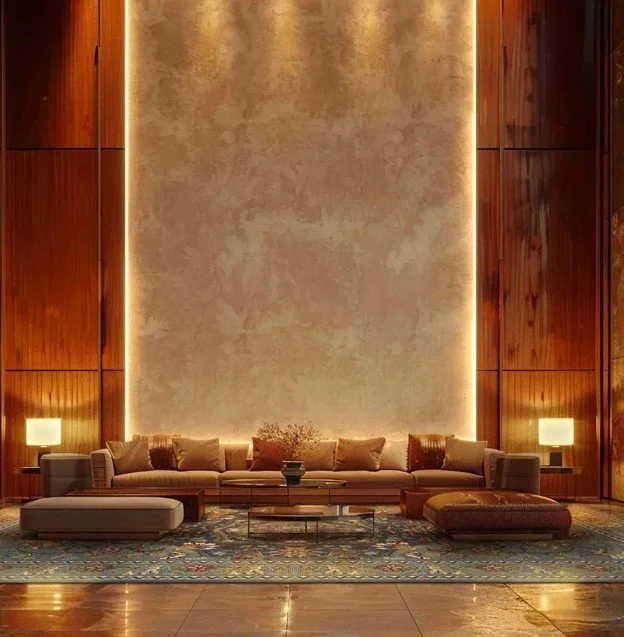
A space does not need elaborate decoration on every surface to communicate those influences. Patterns can be concentrated in the flooring, allowing furniture and architectural finishes to remain relatively simple. Colour can connect the carpet with timber, textiles or decorative objects elsewhere in the room.
The Traditional section of New Traditions offers scope for this approach. Its floral compositions and symmetrical patterns give designers decorative detail to work with, while Axminster weaving and hand tufting introduce different qualities of texture and depth.
Traditional Thai Design in Contemporary Interiors
From Ornamentation to Modern Carpet Design
Adapting a traditional design often involves changing how it is presented. A familiar motif can have a very different presence when enlarged, given a quieter palette or expressed through texture.
The collection’s Modern section develops this idea through changes in scale, monochromatic colours and unexpected surface treatments. Its designs retain references to the past while allowing those references to work within contemporary interiors.
In a hotel with Thai design influences, this creates room for interpretation. A carpet can sit alongside local artwork or crafted furnishings without repeating their decoration literally. The relationship can come through shared colours, shapes or attention to detail, giving each element its own place within the scheme.
The Role of Flooring in Thai Inspired Hotel Interiors
Flooring occupies a substantial part of an interior, making it an effective place to introduce patterns and establish relationships between different areas.
A decorative carpet can frame a seating arrangement or bring detail to an open lobby. Elsewhere, a restrained repeat can support the room’s overall character without becoming its main feature.
New Traditions’ Repeats & Borders section gives designers tools for making those decisions. Borders can define an area within a broadloom installation, creating a rug effect while keeping the floor continuous. They can also provide a finishing detail for a custom hand tufted piece.
The dedicated Runners & Stairs designs extend that thinking into connecting spaces, helping corridors and stairways relate to the rooms around them.
An interior’s connection to place comes from the choices made across the whole space. Flooring contributes alongside architecture, art, materials and furnishings.
For a hotel drawing on Thai heritage, a traditional carpet pattern can support that broader design story. The choice should respond to the property’s particular influences, with colour and composition connecting it to the surrounding interior.
New Traditions allows customisation in colour, scale and fibre. Designers can therefore adapt a starting pattern to the project, giving it a specific relationship with the room rather than treating it as a fixed decorative addition.
Cultural Identity in Contemporary Hospitality Design
Royal Thai’s Approach to Traditional Design
Royal Thai’s carpet manufacturing heritage dates to 1967. New Traditions draws on that experience, combining classic motifs with the construction and customisation options required by contemporary hospitality projects.
The collection offers a practical example of how heritage can continue to inform modern interiors. Designers can preserve intricate detail, simplify its expression or change its proportions to suit a different setting.
For Thai inspired spaces, that leaves plenty of room to move forward while keeping traditional design part of the conversation. History gives the pattern its starting point. What happens after that is down to the room.